Originally published in the February 2008 MAGAZine Newsletter.
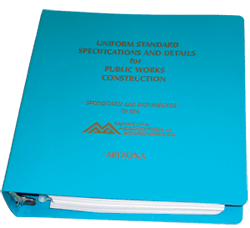 Can you name the best-selling document in the MAG archives? The most downloaded file on the MAG Web site? Many may be surprised to learn that it is not the Regional Transportation Plan or latest air quality plan, but rather the MAG Uniform Standard Specifications and Details for Public Works Construction, better known as the MAG “Specs and Details.”
This document has been voluntarily adopted by MAG cities and towns and has become the de facto construction manual for public works projects throughout the region. The MAG specifications and details are used by manufacturers, contractors, and local governments to ensure public works projects are constructed safely and according to accepted industry standards.
The document includes written specifications (the Specs), which provide definitive descriptions on the use of materials, methods of construction, and project evaluation requirements; and technical drawings, (the Details) that visually depict required construction materials and dimensions. The book includes requirements for earthwork, street construction and related work such as sidewalks and curbs, water and sewer construction, bridges, catch basins, and requirements for various materials such as asphalt, concrete and piping.
The group responsible for keeping the document up-to-date is the MAG Standard Specifications and Details Committee, which consists of representatives from member agency engineering departments and advisory members from the construction industry.
“The committee is a working partnership between government agencies and industry that enhances the quality of the region’s infrastructure,” says Committee Chair Robert Herz, who is a Maricopa County engineer. “It ensures durable high quality at reasonable cost through the continuous quality improvement of standards that incorporate technical advances in construction and design.”
Herz says the committee process provides an open forum for discussions among the various agencies and industry, and the group relies on the experience of its members to create uniform standards that provide the most practical solutions.
Standardizing building materials and public works specifications was recognized as need at MAG’s very first meeting in April 1967. MAG published the first Uniform Standard Specifications and Details for Public Works Construction in 1978. A complete revision was done in 1998 and yearly updates have been made since then to incorporate the use of new materials and methods.
The committee is currently working on new revisions to the document. Cases now under consideration include a complete rewrite of the asphalt concrete materials and construction sections, the addition of plastic PVC catch basins, and reviewing current details for compliance with the Americans with Disabilities Act.
Jeff Benedict, a committee member who represents the Arizona Chapter of the Associated General Contractors, has been a champion of revising the asphalt standards.
“The introduction of new binders, and a change in mix designs challenged the industry to make major changes. To incorporate the new technologies and remove outdated standards, the industry felt the rewrite was important,” says Benedict. He notes that the process of developing concise, workable specifications has taken three years.
“The process included input from commercial laboratories, paving contractors, hot mix producers, and public agency engineers. The goal is to have a clear, workable, ‘living’ document that will be approved by the committee this year.”
Another important task for the committee is to share the best practices of the agencies, standardize them, and incorporate them into the MAG document for use by all jurisdictions. Often, city engineering departments will approve the use of new materials or construction methods by introducing a supplement to MAG standards. Over the years these “city supplements” have grown. While they may fit the needs of the individual agencies, differing standards can cause difficulty for contractors working on similar projects throughout the Valley, or on the same project when the project crosses jurisdictional boundaries.
Last year, MAG completed a project to gather, inventory, and compare all member agency supplements. A working group of the committee is using information gathered from the study to target areas where city supplements can be reduced by incorporating them into the MAG document. The 2008 update includes a case sponsored by the city of Phoenix to standardize fire hydrants, and one sponsored by Maricopa County to incorporate its supplements to the concrete structures section. Mr. Herz anticipates additional cases this year.
“By creating a uniform, standard specification, agencies reduce the need for supplemental specifications and benefit from lower costs, since contractors can be more efficient in the use of the same materials and construction methods,” Herz says. “Standardizing other agency’s supplements into MAG’s Specs and Details also benefit smaller, fast-growing communities that do not have the engineering staff necessary to create their own specifications.”
While few outside of MAG are aware of the committee’s existence, Herz says the important work will continue. “The dedicated engineering professionals and industry experts serving on the MAG Specs and Details committee are committed to ensuring that, as our region continues to grow, MAG will continue to provide the technical standards our public works infrastructure requires,” he concluded.
 Gordon Tyus